

Internet disruption: A look into the role of the Ghana Internet Exchange

Ghana’s recent Internet disruption underscored the critical role of the Ghana Internet Exchange (GIX) in ensuring Internet stability. GIX plays a vital role in enhancing the efficiency, reliability, and performance of the internet, ultimately benefiting both service providers and end-users alike.

Organizations that exchanged traffic to the GIX were left less impacted as compared to those that did not connect at the GIX.
This episode highlighted the GIX’s importance as a robust platform for local internet traffic exchange.
Peering at the GIX offers several advantages:

Enhanced Redundancy: By peering with the GIX, institutions like MTN, Telecel, AT, and the likes of ISPs can exchange internet traffic locally thereby reducing the risk of any international interconnection.

Improved Efficiency: Peering facilitates direct traffic exchange within Ghana, bypassing international connections and reducing latency; the time it takes for data to travel.

Cost Savings: Peering at the GIX can potentially lead to lower international bandwidth costs compared to solely relying on international providers. Members can reduce their reliance on expensive long-distance links and transit providers.

Major Players already on board: The GIX boasts of partnerships with prominent content delivery networks (CDNs) like Meta (Facebook), Google, and Akamai. Netflix is also expected to go live at the GIX in a couple of weeks. This signifies the exchange’s role as a central hub for internet traffic within Ghana.


A Call to Action for Critical Institutions

Given the GIX’s proven stability and the advantages of peering, critical institutions like financial institutions, ECG, National Identification Authority, Ghana Water Company, and the likes must consider peering with the GIX. This would strengthen Ghana’s Internet infrastructure and ensure continued connectivity for essential services during unforeseen circumstances.
By embracing the GIX, these institutions can:

Safeguard Operational Continuity: Mitigate risks associated with disruptions on international routes, ensuring uninterrupted service delivery.

Enhance Customer Experience: Offer seamless online services to their customers by maintaining reliable internet connectivity.

Contribute to a More Robust Internet Ecosystem: Promote a more resilient internet infrastructure within Ghana, benefiting all stakeholders.

Reduced Latency: By interconnecting different ISPs and Telco networks at a central point, GIX facilitates direct data exchange between them. This direct routing can significantly reduce latency, resulting in faster data transmission and improved overall network performance.

Local Content Delivery: GIX facilitates the exchange of local and regional content among members and content providers. This can result in faster access to locally hosted websites, applications, and services, as traffic doesn’t need to travel to and from any international links to reach its destination.

Promotion of Internet

Ecosystem: By bringing together ISPs and Mobile Network Operators (MNOs), content providers, network operators, and other stakeholders, GIX fosters collaboration and innovation within the Internet ecosystem. This can lead to the development of new services, technologies, and business opportunities that benefit the broader Internet community.

The recent Internet disruption, no doubt, served as a stark reminder of the importance of a robust internet infrastructure. By peering with the GIX, critical institutions can safeguard their operations, enhance customer experience, and contribute to a more resilient Internet for Ghana.

Already, GIX has collocation spaces in data centers such as PAIX, NITA, ONIX, and MDXi Appolonia with some others in the offing.

ISPs and critical service providers need to consider localizing some of their content to avoid any other unforeseen disruptions within the Internet ecosystem.
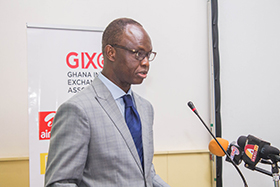
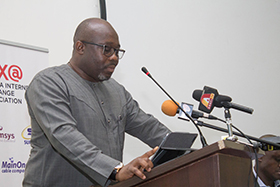
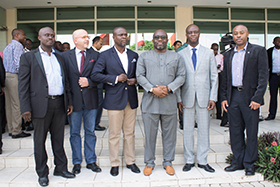
Michael Nfodzo is new GISPA President

The Ghana Internet Service Providers Association (GISPA) has inducted into office Michael Komla Kumah Nfodzo as the association’s new president. Mr Nfodzo succeeds Ing Richard Densu, of MTN who has led the association for two consecutive terms.

The colourful ceremony, which took place at the African Regent Hotel in Accra, had in attendance members of the association and other stakeholders within the internet industry.

Mr Nfodzo was elected together with four others; Daniel Kofi Ansa Akufo of INET Communications, Isaac Teye Ayiku of Dolphin Telecom, Peter David Kotoko of Dimension Data, and Emmanuel Kwarteng of MainOne to constitute the GISPA governing board for the next two years.

In his address after the oath of office, Mr Nfordzo appreciated members of the association for the honor to lead in the capacity as the President and Chairman. He pledged his commitment to the members and the constitution of the association while also calling on all members to give the desired support in executing the mandate. He indicated that although the erstwhile leadership has chalked several successes, there is still much more to achieve going into the future. Key among them is to become a thought leader on key national policy dialogue relating to the internet service industry in Ghana.

“We have achieved a lot together in the past years, but we must look to the future again for more successes and deliver collectively on the heavy mantle handed to us. There are several calls for GISPA to lead conversations with policy makers around reducing the cost of doing business; there is also the need to contribute to National Industry dialogues and etch our association as an indispensable stakeholder. These will be our key focus even as we continue collaborating with the government, stakeholders and other policymakers to create the required environment for more value for all GISPA members.” – Mr Nfodzo said.

The outgoing President, Ing Richard Densu, recounted the hard work and dedication that went into rebuilding the association and admonished members to uphold the tenets of the industry and work towards making their work as internet service providers more impactful. He said although COVID-19 impacted the business sustainability of members, it also provided valuable lessons on ways to innovate and improve with disruptive technologies.

Ing. Densu also urged the new board to expand the annual Ghana Internet Conference to attract more sponsors, stakeholders and partners, increasing the association’s recognition in the industry. He also called for the retooling of the research desk to function efficiently, as it will constitute a critical area of growth for the association in the coming years.

GISPA is a non-profit trade association representing the interests of local ISPs and other internet providers. The association aims to lobby the government and regulatory bodies to grow the internet in the region and make it easier for the community to access effective communications services.


GISPA elects new Board and President

The Ghana Internet Services Providers Association (GISPA) has elected Mr. Richard Densu as President.  Mr. Densu replaces Mr. Ernest Brown, who served as GISPA President for three terms. Mr. Densu represents MTN on the GISPA Board. George Gabla of Internet Solutions Ltd, Kwesi Nkrumah of Comsys Ghana Mr. Michael Nfodzo of Vodafone and Emmanuel Kwarteng of Main One were also elected to the GISPA board.


In his acceptance speech, Mr. Densu, an ICT professional with over 15years experience in the industry and a member of the previous board, thanked all GISPA members and the board for electing him as GISPA President and pledged to leverage his position for the interest of the industry and for members to feel part of GISPA. He also said he would work to improve the outlook of the association by putting in place appropriate structures that will impact it positively.

The new GISPA President also pledged his commitment to help fight cybercrime in Ghana and asked for the support of the board to help champion the fight against cybercrime and other related issues that affect the industry and the country as a whole. He also called for more engagements with stakeholders within the ecosystem in order to move the Internet industry forward.

The new leadership will be issuing out a programme of activities in the coming days, first of which will be a handing over ceremony and media engagement.

The Ghana Internet Services Providers Association (GISPA, www.gispa.org.gh), is a professional, non-profit trade association representing the interests of local ISPs and other internet providers.

The strength of the association rests on its ability to be truly representative of the Ghanaian internet industry as a whole. GISPA currently has eighteen (18) members.


Ghana Internet Exchange Point roadshow

The Ghana Internet Services Providers Association (GISPA) and Ghana Internet Exchange (GIX) collaborated with Internet Society to organize the maiden edition of an Internet Peering and Interconnection Roadshow at the Swiss Spirits Hotel in Accra on 25th April, 2017. This roadshow brought together stakeholders from academia, private sector, regulator and government to deliberate on peering and interconnection issues in Ghana.

In his opening remarks, the GIX Manager Mr. Emmanuel Kwarteng welcomed all stakeholders to the event and spoke about the importance of the Ghana Internet Exchange Point and the need for a deliberate effort to grow its presence in Ghana. He also hinted on ongoing discussions to connect the exchange point of Nigeria to that of Ghana, and plans on setting up a second point of presence at RackAfrica data center.

In his welcome statement, the GISPA President, Mr. Ernest Brown sought to explain the relationship between GISPA and GIXA and the role GISPA played in the formation of the Ghana Internet Exchange (GIX). He explained the purpose of the GIX and said that it was the reason for the Peering and Interconnection roadshow. He went on to say that “the focus of the roadshow is on developing interconnection and traffic exchange opportunities by bringing together key players – infrastructure providers, Internet service providers (ISPs), Internet Exchange Points (IXPs), content producers and providers, data center operators, policy-makers and regulators, to advance the peering ecosystem in Ghana and by extension Africa”.

Mr. Brown went on to say that his pre-occupation as GISPA President is to “ensure that the GIX grows stronger moving forward” and stated that this roadshow affords GISPA the opportunity to convince more infrastructure providers, Internet service providers (ISPs), Internet Exchange Points (IXPs), content producers and providers, data center operators to interconnect at the GIX and gain the immense benefits thereof.

The Director General of the National Communications Authority was present and also gave a keynote address. In his speech, he spoke of the significance of the Roadshow to the people of this country collectively, and the importance the NCA places on the stake it has in the network initiated in 2005, which undoubtedly reduced the cost of electronic service delivery and has a potential to meet the telecom needs of the people of this country and beyond. He also spoke on the service excellence required of the GIX. “Ladies and Gentlemen, let me at this juncture state that the greatest expectations of the people of this country are the facilitation of high quality service experience delivery, access and affordability in the telecom sector. It is in this light that a greater responsibility is required of the GIX network to ensure the provision of high quality of service delivery for all their customers, to yield the desired dividends that are mutually beneficial to both parties”. He also mentioned that it makes sense for all local content produces to host their content in Ghana to make it easily accessible to the Ghanaian end user and encouraged all such producers to peer directly at the exchange to widen their reach as most providers already peer at the exchange.

The Guest of Honour for the event was the Deputy Minister for Communications, Hon. George Andah. Hon Andah, reiterated on the importance of the GIX which allows Internet Service Providers, Network Operators and other peers to exchange traffic within Ghana, while improving connectivity and quality of service to the end user. He also indicated that the Government of the day would create the enabling environment and also work to enhance greater competition among private sector players so that they would be encouraged to invest resources to improve upon their services.

Hon Andah indicated also the need for local content producers to produce more content and encouraged them to host them in the Country, which currently has reliable data centers and also peer at the Ghana Internet Exchange Point.

The facilitator from Internet Society Michuki Mwangi, took all stakeholders through the importance of the having this roadshow. He went through several presentations with stakeholders throughout that day on peering best practices, peering and transit business development and advancing the peering ecosystem.


Media clippings

Embrace Ghana Internet Exchange – Businesses urged http://3news.com/embrace-ghana-internet-exchange-businesses-urged/

GISPA holds workshop for Internet Service Providers http://www.graphic.com.gh/news/general-news/gispa-holds-workshop-for-internet-service-providers.html

PHOTOS: GISPA GIX organize one day roadshow https://frontpageghana.com/index.php/business/item/1036-photos-gispa-gix-organise-one-day-roadshow

Embrace Ghana Internet Exchange – Businesses urged http://enterghana.com/embrace-ghana-internet-exchange-businesses-urged/


GISPA re-elects President

The Ghana Internet Services Association (GISPA) has re-elected Mr. Ernest Brown as its President. Mr. Ernest Brown was re-elected at the association’s general meeting held at the Coconut Regency Hotel last Tuesday, January 26.

At the same event, Mr. Alexander Sulzberger of Ecoband Networks Ltd, Pearl Anakwa of MTN, George Gabla of Internet Solutions Ltd and Emmanuel Adjei of Airtel were also re-elected as a member to the GISPA board.

In his acceptance speech, Mr. Brown thanked all members for continuing to repose confidence in his leadership and renewed his desire to continue to work to improve the outlook of the association by putting in place appropriate structures that will impact it positively.

He also bemoaned the general difficult conditions businesses are facing currently and stressed that the associations members may be forced to increase prices of internet services. He said “GISPA will engage with all stakeholders, especially government, to discuss the unacceptably high costs of doing business in Ghana. The business environment needs to improve, otherwise members may be forced to increase the prices of internet services due the high cost of doing business”.

The Ghana Internet Services Providers Association (GISPA, www.gispa.org.gh), is a professional, non-profit trade association representing the interests of local ISPs and other internet providers. The strength of the association rests on its ability to be truly representative of the Ghanaian internet industry as a whole. GISPA currently has sixteen (16) members.


Press Release: GISPA re-elects Mr. Ernest Brown as President

The Ghana Internet Services ProvidersAssociation (GISPA) has re-elected Mr. Ernest Brown as its President.

Mr. Ernest Brown was re-elected at the association’s general meeting held at the Coconut Grove Regency Hotel last Thursday, November 21. At the same event, Mr. Alexander Sulzberger was also re-elected as a member to the GISPA board. Three new members; Richard Densu of MTN, George Gabla of Internet Solutions Ltd and Emmanuel Adjei of Airtel were also elected to the board.

In his acceptance speech, Mr. Brown renewed his desire to continue to work to improve the outlook of the association by putting in place a restructuring exercise to make it more vibrant and improve its advocacy for the consumer. He also said the new board will embark on a yearly publication of internet statistics to determine the actual contribution of its members to economy of Ghana.

Mr. Brown further cautioned that the new increases in Value Added Tax (VAT) rates had the tendency of increasing prices of internet services in the country. He therefore urged the government to consider giving tax rebates to Internet Service Providers (ISPs) to make up for the VAT increases.

The Ghana Internet Services Providers Association (GISPA, www.gispa.org.gh), is a professional, non-profit trade association representing the interests of local ISPs and other internet providers. The strength of the association rests on its ability to be truly representative of the Ghanaian internet industry as a whole. GISPA currently has twenty (24) members.


ISPs push for tax waivers on modems

The Ghana Internet Service Providers Association (GISPA) has asked Government to strongly consider waiving taxes on modems used to access the Internet, otherwise known as terminal equipment.

According to GISPA, whose membership comprises all firms authorised to provide Internet services to homes and offices, taking taxes off Customer Premises Equipment, access modems, dongles, among others, will help to reduce the cost of entry into the Internet sector and improve the Internet access rate in the country.

GISPA made the appeal in Accra when members of the association called on the Minister of Communication Edward Omane Boamah, and his deputy, Victoria Lakshmi Hamah, to offer their support to the newly-appointed duo mandated to lead the formulation and implementation of policies to guide growth in the communication sector.

The Internet Service Providers’ appeal for taxes on access modems to be removed mirrors Government’s previous decision to waive import duties on mobile voice access devices, specifically mobile phones, which has helped to shoot-up access to mobile phone telephony services and subscription rates.

“As part of efforts to improve Internet usage in this country, we are faced with the issue of taxes on terminal equipment. If you take the mobile network operators, there are no taxes on their devices.

“But when it comes to purely Internet service provision, we pay huge taxes on the equipment that the users are going to use. One of the reasons why growth in the Internet services sector has not really reached the level we want is that the cost of entry is always high.

“We are looking to work with you so that we can look at some of these taxes, and make sure that we get more users to have Internet access to reduce the cost of entry,” said the President of GISPA, Ernest Brown.

The Minister of Communication, Edward Omane Boamah, said Government sees the Internet industry as a critical sector needed to empower people and improve economic activities, and will always support private sector interventions that enhance access to technology services.

“In terms of subscription to mobile telephony, the figures are way ahead of the use of Internet in Ghana, which is why Government will always engage the sector to provide essential services to people.”

He said the need to increase Internet access also raises a new challenge as to how to realign revenue generation without cutting Government’s source of revenue for development.

He said Government is aware of the unhealthy and strained relationship between ISPs and traditional voice network operators, and has arranged to meet the Ghana Telecom Chamber to help ensure that the work of the two parties is complementary and in tandem with each other for betterment of the industry.

According to the International Telecommunication Union (ITU) report for last year, the Internet user population of the country is now 14 percent, which suggests that one in seven Ghanaians now has access to the Internet, an improvement over what used to pertain in the country two years ago when only one out of 10 Ghanaians had access to the Internet.

The Internet penetration rate in the country, however, is far off the more than 100 percent penetration rate recorded in the voice telephony sector.

Some analysts argue that the penetration rate of the country could be higher than the 14 percent reported by the ITU, as more people now access the Internet on their mobile phones in areas where fixed or wired Internet subscription is non-existent.

According to the ITU, the country’s performance in the Internet sector last year has placed Ghana as the 15th-best country in Africa in terms of Internet users per population.

Ghana, which was the first country in sub-Saharan Africa to pioneer Internet usage in homes and offices in 1993, now falls behind countries like Seychelles, Mauritius, South-Africa, Cape Verde, Botswana, Namibia, Gabon, Kenya, Zimbabwe, and Swaziland.

Industry players have thus called for regulatory and policy interventions to propel growth in Internet usage, as the entry of international bandwidth providers has helped to bring down  by about half the cost of accessing Internet services in the country — resulting in enhanced Internet user-experience.


ISPs in merger talks

Some Internet Service Providers (ISPs) are in talks to merge their operations in order to strengthen their competitive position in an industry that is now dominated by the mobile network operators B&FT has learnt.

The decision by the ISPs to consolidate their operations has become necessary as a result of entry of the mobile network operators into the Internet service provision business, which has pushed many ISPs out of business.

However, it is not yet known which of the companies are close to having a deal as most of the 20 ISPs are in talks with one another to find ways of harmonising their capacities and capabilities to ward off threats by the mobile network operators.

The Secretary of the Ghana Internet Service Providers Association (GISPA), Eric Osiakwan who disclosed this to the B&FT in an interview in Accra, declined to provide details of the firms that are currently in the merger talks as he is not authorised to do so.

He said some of the negotiations have reached an advanced stage, which should result in a couple of mergers by the end of the year.

“Some of the members of GISPA are coming to the reality that it is time to consolidate their operations and build on each other’s strength. So, very soon, you may hear some consolidations in the marketplace,” he said.

Mr. Osiakwan, who is also the Coordinator of Ghana Connect — an advocacy group dedicated to the promotion of affordable broadband Internet access in the country — said business consolidations in the ISP industry are not happening as fast as members would have wished due to some market forces.

“Consolidations are more driven by market forces, and those factors must be at play before consolidations can happen. Companies don’t merge for merging’s sake. They merge because they have certain complementarities.”

Mobile network operators’ provision of Internet service has contributed largely to the demise of many ISPs, causing disaffection among pioneer Internet entrepreneurs who have accused the national telecom regulator and Government of failing to protect the business interests of local ISPs.

It has been suggested that due to the emergence of destructive technologies, it is time ISPs changed their business model and did business with the telecom network operators by offering services to them to guarantee their stay in business in the years ahead as the telcos shift their concentration from voice to data.

According to some entrepreneurs who have seen their business interest in the ISP market wane, anti-competitive practices exhibited by incumbent network operators as well as the inability of the ISPs to raise capital for investment in newer technologies have cut revenue flow to local ISPs — further impeding their ability to upgrade their technological infrastructure.

Mr. Osiakwan said the existing business operating environment has made the ISPs business a lot more challenging and many more firms in the Internet market will soon fold-up.

“The reality is that a lot of businesses fail in Ghana every day, and that is a testament to the sort of business environment that we have. Unfortunately, that is reality; and definitely some of the ISPs will go down by the end of the year. That is the nature of the game,” he said.

Ghana, which was the first country in sub-Saharan Africa to engage in the ISP business in 1993, has over the years witnessed the demise of pioneer Internet entrepreneurs — most of whom have moved to other, newer, technology-driven ventures. And those still in business have seen the profitability and sustainability of their businesses weaken year-on-year.

Currently, there are about 149 licenced ISPs in Ghana. However, only about 20 are in operation. And out of the number of ISPs in operation, less than 10 of them are fully-owned by Ghanaians.

Additionally, the topmost players in providing Internet access to homes are the biggest telephony firms in the country who serve both as wholesaler and retailer of international bandwidth.

More so, some of the telcos have gone past the playing-turf of ISPs to invest in Cyber Cafes throughout the country — a move ISPs have described as threatening, unfair and anti-competitive.

By Evans Boah-Mensah, BFT

Source: www.thebftonline.com


Capacity Media Launch West Africa Connect 2013

The world’s most trusted telecoms media brand, launch West Africa Connect 2013; the first west African telecoms summit that will unite regional business leaders with international executives, government representatives, regulatory bodies and global investors.

The recent development of competitive submarine cable systems – ACE, GLO 1, MAIN ONE CABLE, SACS and WACS are now bringing greater levels of international capacity to the west coast of Africa, spurring numerous backbone investments and a flurry of activity in regional infrastructure development.

Among the numerous projects currently being spearheaded, VODAFONE WHOLESALE GHANAhas widely publicised the company’s plans to expand its footprint into neighbouring landlocked nations. Similarly, the GOVERNMENT OF GUINEA is championing an ambitious $350 million project for the construction of a national fibre optic backbone.

The emerging strategic wholesale opportunities in the region have not gone unnoticed in the international carrier community with operators like ETISALAT, ORANGE and MAROC TELECOMactively investing in the market.

Globally respected telecoms media brand Capacity Media is also investing in the region, developing the first edition of the West Africa Connect 2013 executive summit, taking place on the 16 & 17 April 2013 in Dakar. This first event will be an important step for the development of wholesale telecoms in West Africa, by uniting the influential executives who are crucial for driving growth in the market. Regional challenges and opportunities will be brought to the foreground, whilst methods for promoting industry collaboration will be debated. Business leaders will also begin negotiations with the wider international community, encouraging new business and market growth.

Discussing the launch of West Africa Connect 2013, Ros Irving, CEO of CAPACITY MEDIA commented “In the last few years there has been significant developments in the West African wholesale telecoms market and the industry has voiced a need for a neutral regional meeting to discuss market challenges and how best to encourage growth. As producers of the globally acclaimed International Telecoms Week (ITW) and the established Capacity Africa event that is now in its 7thyear, our company is well positioned in the market to develop an event that will connect the right people in the industry and actively contribute to the development of wholesale telecoms in the region.” Participation has already been confirmed from leading executives at AT&T, BHARTI AIRTEL, BT, BICS, ETISALAT, EXPRESSO TELECOM, GOOGLE, LIBTELCO, MAURITEL GROUPE, SONITEL, TOGO TELECOM, VODAFONE, and Telecommunications Ministers from SENEGAL and GUINEA CONARKY among others.

For more information on West Africa Connect 2013 (16 & 17 April 2013, Dakar) please contact Katie Anderson, Conference Producer at Katie.anderson@capacitymedia.com or call +44 (0) 20 7779 7290